
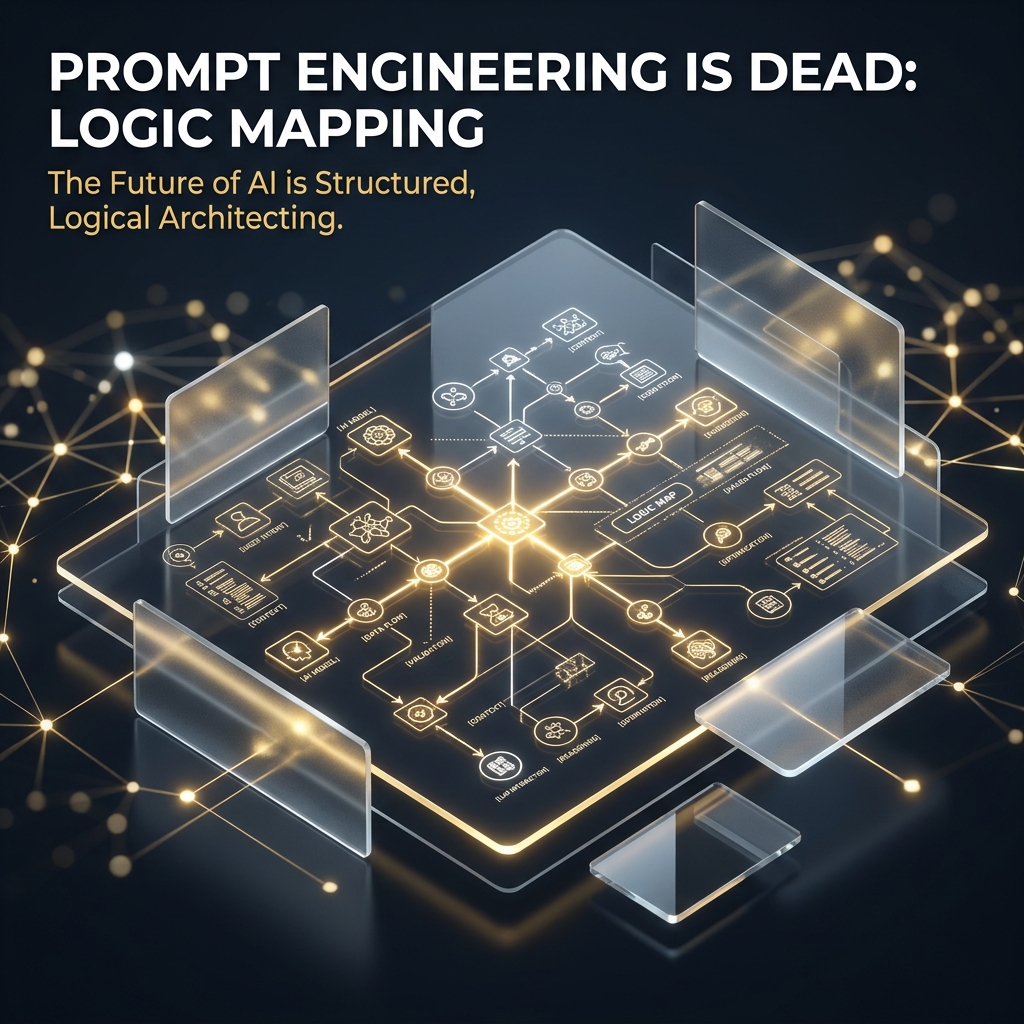
For the past three years, 'Prompt Engineering' was hailed as the definitive skill of the AI era. But as we move deeper into 2026, the ability to whisper the right words to a chatbot is no longer enough. The shift from conversational AI to autonomous agentic swarms has rendered traditional prompting obsolete. Entering the era of 'Logic Mapping.'
Executive Briefing
As Large Language Models (LLMs) have become more reasoning-capable, they no longer require complex linguistic 'hacks' to produce high-quality output. Instead, the bottleneck has shifted to System Architecture. Logic Mapping is the practice of designing the decision-trees, feedback loops, and state-management protocols that allow autonomous agents to operate without human intervention. In 2026, we don't prompt the AI; we architect its reality.
The Death of the 'Prompt Whisperer'
In 2023 and 2024, prompt engineering was about finding the magic sequence of tokens to bypass filters or coax a better response. We used 'Chain of Thought,' 'Few-Shot Prompting,' and 'Tree of Thoughts' as manual overrides. However, models like GPT-6 and Gemini 2.0 now perform these reasoning patterns natively. The 'whisperer' who knows the right adjectives is being replaced by the 'Architect' who knows how to map a business process into a deterministic logic flow.
⚡ The 2026 Shift: Prompt vs. Logic
- PROMPT: "Write a marketing email for a new sneaker release using a bold tone."
- LOGIC MAP: Define an autonomous agent that monitors inventory, triggers a customer segment analysis, cross-references historical conversion data, and autonomously deploys a personalized dynamic-content email when stock hits a specific threshold.
What is Logic Mapping?
Logic Mapping is a multi-dimensional approach to AI orchestration. It involves three core pillars:
1. State Orchestration
In the prompt era, AI was stateless. You sent a message, you got a reply. In the agentic era, AI maintains long-term state across multiple sub-tasks. Logic mapping involves defining the 'Global State'—what the agent knows, what it has done, and what its current goal is—and ensuring this state is synchronized across a swarm of specialized agents.
2. Constraint Engineering
Instead of telling an AI what to do, we now define the boundaries of what it cannot do. Constraint engineering uses hard-coded logic gates and 'Ethical Guardrails' to ensure that an autonomous agent remains within its operational envelope. This is the difference between a chatbot that hallucinated a discount and an agentic system that is physically unable to access the pricing database without a verified manager signature node.
3. Recursive Feedback Loops
A Logic Map includes built-in 'Reflect' nodes. Before an agent executes a high-stakes action, it must pass its proposed output through a 'Critic Agent' that evaluates it against the Logic Map's original intent. If the output fails the criteria, it is recursively fed back for self-correction—zero human input required.
Case Study: The 2026 Autonomous Supply Chain
A global electronics manufacturer replaced their 20-person procurement team with a Logic-Mapped agentic swarm. Instead of humans 'prompting' an AI for supplier recommendations, the system was mapped to the factory's real-time IoT sensors. When a capacitor shortage was predicted, the 'Scout Agent' autonomously identified 50 potential suppliers, the 'Negotiator Agent' secured terms based on pre-set financial logic, and the 'Compliance Agent' verified legal standing. The entire process was mapped in a logic flowchart that humans merely audited.
How to Master Logic Mapping in 30 Days
If you want to stay relevant in the 2026 job market, stop practicing your 'prose' and start practicing your 'process.' Learn to think in flowcharts. Understand the basics of JSON Schema, Agentic Workflows, and Deterministic Middleware. The most valuable person in the room is no longer the one who can talk to the machine; it's the one who can design the system that the machine lives in.
Advanced Logic Mapping Protocols
Temporal Logic
Designing agents that understand the sequence of events and can delay actions based on external triggers (e.g., waiting for a market close before rebalancing a portfolio).
Swarm Consensus
Implementing protocols where multiple agents must 'vote' on a decision to minimize the risk of single-agent hallucination.
Conclusion
The era of prompting was a brief transitional phase. It was the training wheels for a world where machines finally understand us. Now that they do, the real work begins: architecting the logic that will govern the autonomous future. Prompt engineering is dead. Long live the System Architect.